Free Delivery On All Orders Over $100

Full Body vs Partial Silicone Reborn Dolls

Full Body vs Partial Silicone Reborn Dolls (2026): Which One Is Actually Right for You?
Here’s the question I get more than any other: “What’s the actual difference between full body and partial silicone — and does it really matter?”
It matters. A lot. And the wrong choice costs you real money.
The good news? Once you understand what each construction actually delivers — not the marketing version, the real version — the right choice for you becomes obvious. This guide cuts straight to it. No fluff. Just the honest comparison you need to spend your money wisely in 2026.
Want the full deep-dive on full body silicone first? Our Complete Guide to Full Body Silicone Reborn Dolls covers everything — types, pricing, care, and where to buy safely.
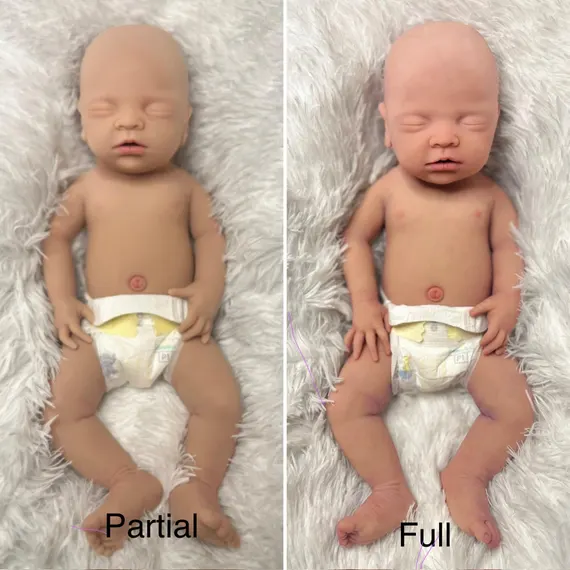
What You’re Actually Comparing
Let’s define both clearly, because the terms get misused constantly online.
A full body silicone reborn doll is built entirely from platinum-cure silicone — head, torso, arms, and legs — with no cloth, no hybrid body, and no internal stuffing. Every surface you touch is silicone. Every part flexes, warms, and responds consistently.
A partial silicone reborn doll — also called a silicone-cloth hybrid — uses platinum silicone only for the head, hands, and feet. The torso is a soft cloth body, weighted internally with glass beads or polyfill. It’s the most common type on the market. It’s often the first type new buyers encounter.
Both are genuinely beautiful. Both use real platinum silicone where it’s present. The difference is in what happens when you hold one versus the other — and that difference is the whole conversation.
The 6 Differences That Actually Matter
1. Touch — Where the Real Gap Lives
Pick up a partial silicone reborn doll and the experience begins at the face, hands, and feet — and ends there. The moment your hands move to the torso or the upper limbs, you feel the transition: silicone gives way to cloth. It’s subtle for some buyers. For others, it breaks the immersion completely.
Pick up a full body silicone reborn doll and there is no transition. Silicone everywhere — consistent, skin-like, warm. Your hands can move across the back, along the ribs, down the legs, and the material responds identically throughout. The brain doesn’t catch a seam. And that seamless consistency is what collectors mean when they say full body silicone changed everything for them.
If how it feels matters to you — not just how it looks — this is the most important difference of all.
2. Weight and How It Moves in Your Arms
A partial silicone doll concentrates its weight in the cloth torso pouch. The heaviness sits in the center. It’s not wrong — but it’s not quite right, either. You feel the distribution difference as soon as you shift the doll in your arms.
A full body silicone reborn distributes weight naturally throughout the entire body: head heavy, limbs settling, torso present. When you reposition it, the weight shifts the way a sleeping newborn shifts. That specific, settled, distributed heaviness is what activates the deepest nurturing response — and it’s something partial construction genuinely cannot replicate.
For therapeutic use especially, this weight difference is clinically meaningful.
3. Bathing
Simple and non-negotiable. A full body silicone reborn doll is completely water-safe — everywhere, all at once. You can give it a full gentle bath in lukewarm water without a second thought.
A partial silicone doll with a cloth body can never be submerged. Water inside the cloth torso creates mold, structural damage, and eventually ruins the doll. Surface cleaning of the silicone parts only — that’s the limit. If bathing is something you want to do — for therapeutic routine, caregiving practice, or realistic daily care — full body is your only real option.
4. Posing
Full body silicone allows posing across every part of the body. Many include internal wire armatures that let limbs hold natural positions independently — curled newborn poses, outstretched arms, natural sleeping positions. For photography and display, this is invaluable.
Partial dolls are limited by their cloth body construction. The silicone limbs pose well; the torso is constrained by the stuffing and internal structure. Good for dressing and display. Not the same as full body poseability.
5. Price
This one is straightforward. Full body silicone costs more to produce — more material, more complex casting, more labor — and that cost passes to the buyer. Honestly.
| Type | Typical Price Range (2026) |
|---|---|
| Partial silicone (silicone-cloth hybrid) | $80 — $400 |
| Full body silicone — entry level | $150 — $350 |
| Full body silicone — mid-range | $350 — $800 |
| Full body silicone — premium/artist grade | $800 — $10,000+ |
The entry-level price overlap between the two types can mislead buyers into thinking a $180 partial doll and a $200 full body doll are comparable. They’re not. At similar price points, a quality partial silicone doll from a verified artist will often deliver better paint detail than an entry-level full body. Know what you’re optimising for — touch or visual detail — and price accordingly.
For buyers working within a tight budget, our Best Silicone Reborn Dolls Under $300 guide covers both types with honest assessments at every tier.
6. Maintenance
Both types need gentle care. But full body silicone requires it across the entire body — powdering the whole doll regularly, not just the silicone parts. Because platinum silicone is naturally slightly tacky, a full body doll attracts lint and dust everywhere. That means a more thorough — though still simple — care routine.
Partial dolls require the same silicone care on the head, hands, and feet, but the cloth body needs different handling: no water, careful dressing, and monitoring for any internal moisture.
Who Should Choose Full Body Silicone
You’re the right buyer for full body silicone if:
- Touch matters as much as — or more than — appearance
- You want to bathe the doll as part of your routine
- You’re using it for therapeutic purposes — dementia care, grief support, anxiety management
- You’re a serious collector after the maximum realism experience
- You’re in neonatal or childcare education and need realistic weight distribution for training
Who Should Choose Partial Silicone
You’re the right buyer for a partial silicone reborn doll if:
- You’re a first-time buyer managing your budget carefully
- Visual display is your primary goal and handling is secondary
- You want detailed, high-quality paint artistry — often easier to achieve on partial construction at mid-range prices
- You plan to dress and pose the doll frequently and want easier cloth-body flexibility
- You’re buying for a child or as a first-time gift
The partial silicone category has genuine quality at accessible prices. Don’t dismiss it because full body sounds better on paper. For many buyers, a beautiful $250 partial silicone doll from a verified artist delivers more satisfaction than an entry-level $260 full body piece with basic paint work.
The Verdict — Honest and Direct
Full body silicone wins on touch, therapeutic effectiveness, bathing, natural weight distribution, and long-term collector value.
Partial silicone wins on accessibility, paint detail at mid-range prices, ease of first ownership, and value for display-focused buyers.
Neither is universally better. The right one depends entirely on how you actually plan to use and interact with the doll — and how honest you’re willing to be with yourself about that.
If you’re still deciding between the two — or between silicone and vinyl altogether — our Ultimate Guide to Silicone Reborn Dolls covers every material and type in full, with a buying framework that works for every budget and every use case.
Show Image Caption: The natural weight distribution of a full body silicone reborn doll — felt throughout the arms, not concentrated in a central pouch — is what makes it the strongest option for therapeutic use. Image: [siliconereborns.com]
FAQs: Full Body vs Partial Silicone Reborn Dolls
Q1: What is the difference between full body and partial silicone reborn dolls?
Full body silicone means the entire doll — head, torso, arms, and legs — is cast in platinum-cure silicone. Partial silicone (also called silicone-cloth hybrid) uses silicone only for the head, hands, and feet; the torso is a weighted cloth body. Full body delivers consistent silicone texture everywhere and natural weight distribution throughout. Partial is more affordable and better suited to display-focused buyers.
Q2: Is full body silicone worth the extra cost over partial?
For buyers who prioritize touch, therapeutic use, bathing, or maximum realism — yes, clearly. The tactile difference is real and immediate. For buyers whose primary interest is visual display with minimal handling, a quality partial silicone doll often delivers comparable visual results at lower cost. Be honest about how you’ll use it.
Q3: Can partial silicone reborn dolls be bathed?
No. The cloth body in a partial silicone doll cannot be submerged in water — moisture causes mold and structural damage inside the cloth torso. Surface cleaning of the silicone parts only is the limit. If bathing matters to you, full body silicone is your only option.
Q4: Which is better for dementia therapy — full body or partial silicone?
Full body silicone consistently outperforms partial silicone in therapeutic settings. The consistent tactile experience across the entire body and natural weight distribution activate caregiving instincts more powerfully and sustain the therapeutic response more effectively. Clinical research confirms that the most realistic dolls generate the strongest therapeutic outcomes. See our therapy and dementia care guide for the full evidence.
Q5: Which type holds its value better?
Full body silicone — particularly named artist and collector-grade pieces — holds and appreciates in value significantly better than partial silicone dolls. The collector market for full body silicone originals is active and growing. Partial silicone dolls at mid-range retail prices typically do not appreciate.
Q6: Is a partial silicone doll a good choice for a first-time buyer?
Yes — for the right buyer. If you’re managing your budget carefully, want a visually beautiful first piece, and plan to primarily display rather than handle intensively, a quality partial silicone doll from a verified artist is an excellent first purchase. Many serious collectors started with partial silicone before moving to full body.
Q7: What does “platinum-cure silicone” mean and why does it matter?
Platinum-cure silicone is medical-grade silicone — stable, hypoallergenic, odorless, resistant to yellowing, and capable of holding fine surface detail indefinitely with proper care. It’s present in both full body and quality partial silicone dolls. The cheaper alternative — tin-cure silicone or TPE — yellows faster, loses softness within months, and sometimes develops an oily surface residue. Always confirm platinum-cure before purchasing either type.
Q8: Which type is easier to care for?
Partial silicone is slightly easier — the cloth body requires simple handling (no water, careful dressing) while the silicone parts need regular powdering and gentle cleaning. Full body silicone requires the same care across the entire doll — more thorough but not more complex. Full care guidance for both types is in our complete silicone reborn doll care guide.